Labels

2-way (10) passive (10) monitor (9) Active (7) floorstander (6) 3-way (5) PC Speakers (4) b&w (3) 4-way (2) Yamaha (2) 6010B (1) 800 Diamond (1) 802 (1) 802 Diamond (1) A2 (1) Audioengine (1) B2031A (1) Berhinger (1) Creative (1) D1080 (1) ESL (1) Edifier (1) Genelec (1) GigaWorks T20 (1) HR824 (1) HiVi (1) Infinity (1) Mackie (1) Martin Logan (1) NS-1000 (1) NS-10M (1) Nautilus 802 (1) PSB (1) Prelude P-FR (1) R1900 Tiii (1) Revel (1) Synchrony One (1) Truth (1) Ultima Salon 2 (1) Vista (1) a7 (1) altec (1) vintage (1)

Search This Blog

Showing posts with label passive. Show all posts

Saturday, August 24, 2013

PSB Synchrony One


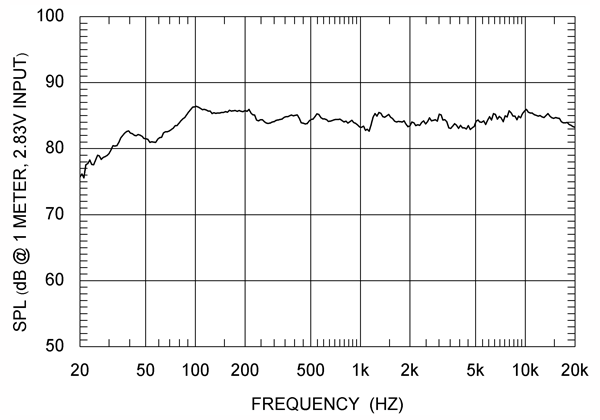
Response curve is an average of five measurements:
on-axis, 15 degrees left and right off-axis,15 degrees up and down off-axis

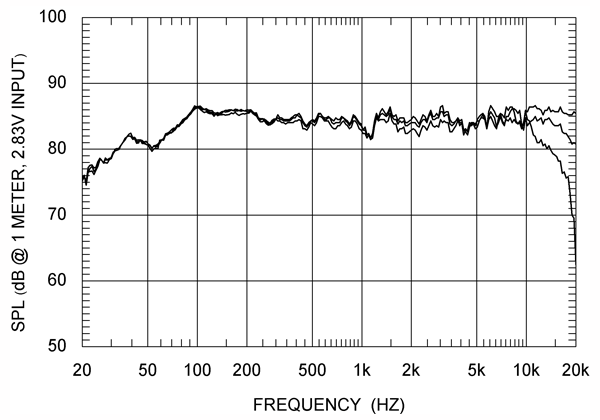
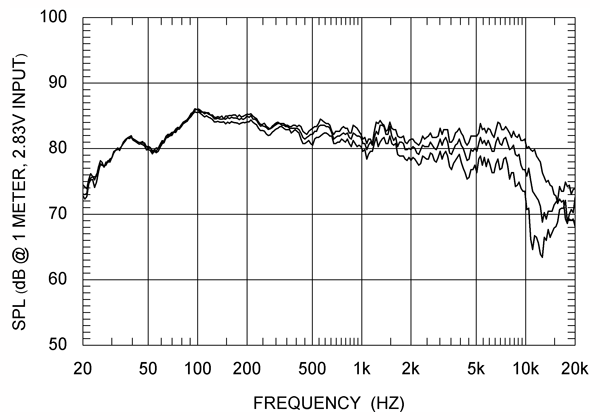
0 / 15 / 30 degree off-axis responses
THD+N @ 90dB (50Hz - 10kHz)


With regard to objective evaluations, PSB Synchrony One is one of the best measured audiophile loudspeakers. I love their nearly-constant direcitivy, truly full range response with great linearity, Needless to say, their price of $4500/pr is extremely competitive comparing with other competitors in the same league (look at the price tags for Wilson Audio Sasha W/P or Revel Ultima Salon 2).

Source: http://www.soundstagenetwork.com/measurements/speakers/psb_synchrony_one/

Revel Ultima Salon 2


Response curve is an average of five measurements:
on-axis, 15 degrees left and right off-axis,15 degrees up and down off-axis

On-axis, 15/30/45/60/75 degrees off-axis responses

Total Harmonic Distortion

If objective measurement can account for most of audiophile-level listening pleasure, Ultima Salon 2 is clearly a perfect loudspeakers for home hifi: wide frequency range, flat free-field response, good directivity pattern, and very low distortion over entire frequency range.

Source: http://www.soundstagenetwork.com/measurements/speakers/revel_ultima_salon2/

Yamaha NS-1000


Measurements should be interpreted very carefully because it's not a free-field response but a in-room response, although the room where NS-1000 was measured behaves very well.

You can also find an alternative crossover design that is claimed to do better than the original one of NS-1000 in terms of harshness in mid/treble.

Source: http://www.troelsgravesen.dk/Yamaha-NS1000.htm

Yamaha NS-10M


FIGURE 18.22 Two small 7- to 8-in. two-way loudspeakers with similar directivity indexes, each one optimized to a different target. (a) The Yamaha NS-10M was designed to have constant sound power. (b) The JBL 4301 was designed to have constant on-axis frequency response.


FIGURE 18.23 (a) and (b) show that the Yamaha NS-10M performance drifted from that of the original version shown in Figure 18.22a. It is now even closer to the performance of the Auratone 5C, shown in (b), but it is slightly smoother and has more extended bass. The loudspeaker in (c) has a basic similarity, but the midfrequency emphasis is moderated. It is lower in amplitude and slightly lower in frequency. The loudspeaker in (d) also has an underlying midfrequency emphasis but adds some high-Q resonances around 600 Hz and 2.5 kHz that add an annoying "personality" to the playback. Why? (e) shows a loudspeaker that seems to be trying to be flat but fails at both frequency extremes: "punchy" bass due to the 80–100 Hz, underdamped woofer bump, and rolled-off high frequencies. The fact that all of these monitors, some more than others, exhibit high-frequency roll-off is puzzling in an age when arguments are being made that bandwidth beyond 20 kHz is a necessity for monitoring.
Manual from the manufacturer


It's a legendary studio monitor, literally. The policy of designing NS10M is quite different from today's perspective. The loudspeakers intended to achieve flat response on not on-axis but sound power. Thus, without further equalization, NS10M might sounds too bright and forwarding under today's room treatments. Due to this characteristic, NS10M is used for checking vocal details in mixing.

Source: Toole, F. (2012). Sound reproduction: The acoustics and psychoacoustics of loudspeakers and rooms. Focal Press. http://www.embedded.com/print/4214420 (Excerpt for Chapter 18.5.)

Bowers and Wilkins (B&W) 800 Diamond


Free-field response (Semi-anechoic)

Acoustic Contribution

Horizontal Directivity

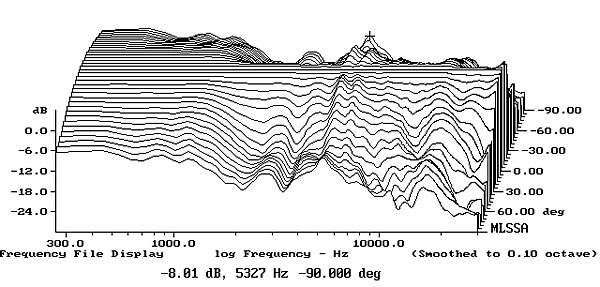
Vertical Directivity


This set of measurements doesn't look bad. But small linear distortion in midrange is appeared. Directivity pattern is not very generous for the price range.


Source: http://www.stereophile.com/content/bampw-800-diamond-loudspeaker-measurements

Bowers and Wilkins (B&W) 802 Diamond


Free field response of 802 Diamond (Purple trace)

On-axis response is clearly less linear than previous B&W models. Some argue that new midrange units of Kevlar cone might result in such linear distortions.

Martin Logan Vista


Lots of dips and peaks are shown in measurements of electrostatic loudspeakers. And it is not quite sure whether such tricky patterns imply acoustic inferiority, although one of recent studies conducted by Olive show listeners may prefer flat-responding typical loudspeakers to Martin Logan's ESL.

Source: http://www.homecinema-fr.com/forum/materiel-haute-fidelite/jeu-des-4-enceintes-inconnues-t29979561-15.html

Infinity Prelude P-FR


These loudspeakers have not only very good characteristics - flat on-axis response (as well as listening window average) and gently upward DI - but also very deep bass extension. Truly full-range.

Source: http://www.homecinema-fr.com/forum/materiel-haute-fidelite/jeu-des-4-enceintes-inconnues-t29979561-15.html

Friday, August 23, 2013

Bowers and Wilkins (B&W) Nautilus 802


Upper: Free field response (black), listening window average (green), first reflection response (red), and sound power response (blue)
Lower: Diectivity Index at first reflection (red) and sound power (blue)

Generally flat response at on-axis is shown, but DI pattern looks a bit problematic at high treble range. Also like the comment in the graph, sound power problem is appeared.

Source: http://seanolive.blogspot.com/2009/11/subjective-and-objective-evaluation-of.html

Altec A7-500 Loudspeaker system


Found the frequency response (guessing it's an on-axis free field response) and and vertical directivity sonogram. Looks very nice. Especially so considering their ages!

Source: http://www.seeko.co.kr/zboard4/zboard.php?id=forum_etc2_1&no=28238